
How Many Cars Does It Take to Drive a 30 Person Group? 8 Costs Smart Organizers Budget For
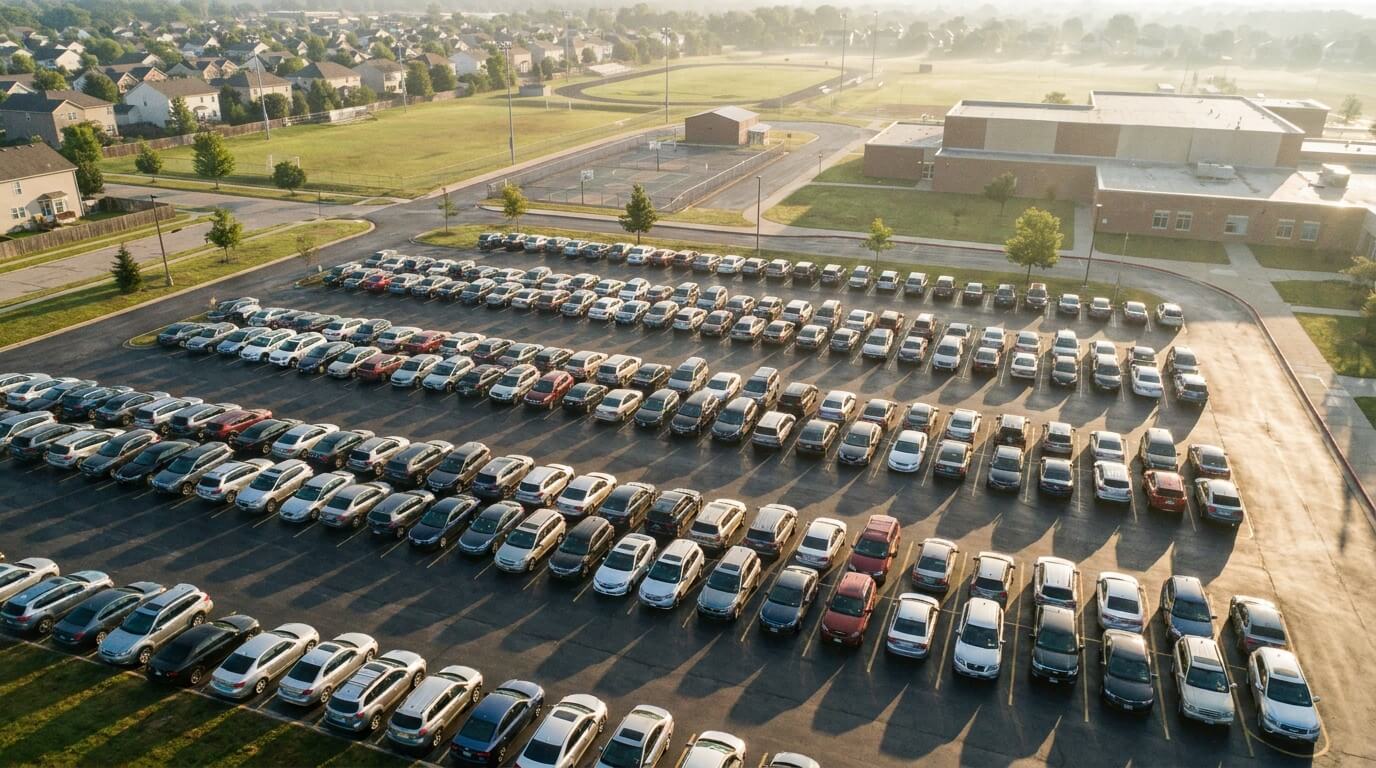
How many cars does it take to drive a 30 person group? For most schools, companies, and churches, the honest answer is seven to eight vehicles once you account for realistic seating, not the four or five people you might picture if everyone squeezed in.
That number is the starting point for a cost most group organizers never actually sit down and calculate, and it is bigger than the gas receipts alone once you add tolls, parking, and the time it takes to keep everyone together.
This guide walks through how many cars does it take to drive a 30 person group, what each of those vehicles actually costs to run for a day, and the coordination problems that show up once a caravan that size hits the road.
If your group is comparing a self-drive plan against a single charter bus, this is the math worth doing before anyone commits their own car.
How Many Cars Does It Take to Drive a 30 Person Group? The Math
A typical sedan comfortably seats four people once you count the driver, and a midsize SUV or minivan can stretch to five or six if nobody minds a tight back row.
Run the math on how many cars does it take to drive a 30 person group and you land at seven to eight vehicles for a realistic mix of sedans and SUVs, or closer to five or six if the group happens to have several minivans available.
Most school, corporate, and church groups do not have six matching minivans sitting in a parking lot.
They have whatever their staff, parents, or members happen to drive that day.
That’s why seven to eight cars is the more realistic answer to how many cars it takes to drive a 30-person group when you are working with a mixed fleet of personal vehicles instead of a fleet built for the trip.
What Each Car in the Caravan Actually Costs
Every one of those seven or eight cars burns its own tank of gas, not a shared one. As of September 14, 2026, AAA reported a national average gas price of $4.3163 per gallon, up 13 cents from the previous week.
Using a conservative 25 MPG assumption for a mixed group of sedans and SUVs, a 100-mile round trip works out to roughly $17.27 in fuel per car.
Multiply that by seven or eight cars and the group’s combined fuel bill for that same 100-mile round trip lands between roughly $121 and $138, before a single toll or parking fee is added.
That is the part a per-person gas estimate hides: nobody feels $17 individually, but once you know how many cars does it take to drive a 30 person group, you can see the group is paying for it eight times over, once per car.
That’s the first layer of cost behind how many cars does it take to drive a 30 person group. Tolls stack the same way.
A turnpike or bridge toll that costs one driver a few dollars costs the group that toll multiplied by however many cars are in the caravan, since every vehicle pays its own fare independently.
These are estimates that will vary by route and toll authority, so treat them as a planning range rather than a fixed number, and check current AAA pricing before you lock in a per-car fuel estimate for your own trip.
The Parking Problem Nobody Budgets For
Fuel and tolls are the costs a spreadsheet catches. The one it usually misses is parking, because finding one space is easy and finding seven or eight spaces together at a stadium, a conference center, or a downtown venue is a different problem entirely.
Answering how many cars does it take to drive a 30 person group is only half the exercise; the other half is where all of those cars are going to sit once the group arrives.
Once you’ve settled how many cars does it take to drive a 30 person group, the next question is where they all park. Destination parking is rarely priced or laid out for a group of seven or eight vehicles arriving together.
Lots fill up, garages cap out, and a caravan that started the trip together often ends up scattered across two or three different parking areas within walking distance of each other, which is its own coordination headache before the group has even gotten where it’s going.
The Coordination Cost That Doesn’t Show Up on a Receipt
Gas, tolls, and parking are the costs you can put a number on.
The cost that’s harder to price is what happens to a group’s schedule once it’s split across seven or eight cars driven by seven or eight different people with seven or eight different bladders, phone battery levels, and senses of direction.
This is the part of how many cars does it take to drive a 30 person group that has nothing to do with money. One car takes a wrong exit. Another stops for gas the others didn’t need. A third loses the group text thread somewhere around hour two.
None of this is anyone’s fault, it is just what happens when you ask how many cars does it take to drive a 30 person group and then hand each one to a different driver with a different phone and a different idea of how fast to go.
This is where how many cars does it take to drive a 30 person group stops being a math question and starts being a scheduling one. For school trips, that means a teacher doing a headcount at three or four separate arrival times instead of one.
For corporate events, it means the meeting doesn’t actually start until the last car clears the parking garage. For church groups, it means the service or retreat schedule bends around whichever car got stuck in traffic.
A single departure point and a single arrival time remove that entire category of problem, which is exactly what one charter bus does for a group this size.
Why This Math Changes at 30 People
The answer to how many cars does it take to drive a 30 person group changes a lot depending on group size. Smaller groups can often get away with two or three cars, and at that scale, self-driving is genuinely simple to coordinate.
We’ve broken down that smaller-group math separately in our comparison of charter bus cost against everyone driving themselves, which is worth a look if your group is closer to a dozen people than thirty.
Thirty people is where the math shifts. At two or three cars, one wrong turn or one late arrival is a minor annoyance.
At seven or eight cars, it’s a near certainty that at least one car falls behind, and the group’s plans for the day end up built around whichever car is slowest rather than the group as a whole.
That’s the point where the question stops being how many cars does it take to drive a 30 person group and starts being whether driving separately is the right plan at all.
What One Charter Bus Replaces
Once you’ve worked out how many cars does it take to drive a 30 person group, the case for one bus starts to make itself.
A single charter bus turns seven or eight separate fuel tanks, seven or eight separate toll accounts, and seven or eight separate parking searches into one departure point and one arrival time.
The group leaves together and arrives together, and whoever is organizing the trip is coordinating one driver instead of seven or eight.
This is the same logic that makes charter travel a common choice for corporate offsites headed to nearby cities.
If your group is a company team based near the capital, our guide to corporate charter bus rental in Washington D.C. covers the same one-bus-versus-many-cars decision from that angle.
Schools weighing the same choice for a class trip can find a closer parallel in our guide to school field trip bus rental in Philadelphia.
Express Bus has run East Coast charter trips since 2013.
The quote request process asks for your group type, passenger count, trip type, and stops.
That lets a single-bus plan get built around your group’s actual headcount instead of a rough guess at how many cars it takes to drive a 30-person group.
Frequently Asked Questions
How many cars does it take to drive a 30 person group if everyone carpools? Carpooling can bring the number down from eight cars to six or five if enough people are willing to double up, but it rarely gets a 30-person group below five vehicles once you account for realistic seating.
Is seven to eight cars always the right number for a 30-person group? It depends on what your group actually drives. A group with several minivans might manage it in five or six vehicles, while a group relying mostly on sedans could need eight or more.
Count actual seats, not seat capacity on paper, before you commit to a number.
Does the $17.27 fuel estimate apply to any trip? No. That figure is an illustrative example based on a 100-mile round trip, a 25 MPG assumption, and the AAA national average gas price recorded on September 14, 2026.
Gas prices change weekly, so recalculate with the current AAA average and your group’s actual mileage before relying on any number.
What if only some of the group needs a ride? That’s still worth totaling up.
Even a 20 or 25 person group typically needs five to seven vehicles once you apply the same seating math, and the coordination cost of multiple cars shows up at any group size above a handful of vehicles, not just at 30 people.
Where does the seven-to-eight car estimate come from? It comes from a simple seating count: divide 30 passengers by a realistic four to five seats per personal vehicle.
That’s the basic math behind how many cars does it take to drive a 30 person group, and it’s the same math worth running for any group size before deciding how to travel.
Can a charter bus pick up from multiple locations? The quote request form has a Stops field built for exactly that, where you can list a departure point, one or more pickup stops, and a final destination, so a group that isn’t all in one place can still travel together on one bus.
Does group type change how many cars does it take to drive a 30 person group? Not the vehicle count itself, but it changes the stakes.
A school or church group has a fixed schedule to keep, while a corporate group has a meeting time to hit, so the coordination cost of multiple cars lands differently depending on what the group is trying to do once it arrives.
Ready to trade seven or eight cars for one bus? Submit a charter bus quote request with your group’s passenger count, departure point, and trip type, and get a plan built around your group’s actual size instead of a caravan of borrowed cars.